
University of Missouri School of Medicine MU Health School of Medicine
News Divider


Loading video...


MU Awarded $8.5 Million to
Explore Tiny Vessels' Role
in Cardiovascular Diseases


One of MU's largest medical research grants will advance study of America's No. 1 killer

One of the largest medical research grants ever awarded to the University of Missouri was announced by MU scientists and administrators on May 6, 2010. The National Institutes of Health grant will help answer important questions about such prevalent health problems as high blood pressure, diabetes and stroke. The conditions are closely associated with cardiovascular disease, which is the leading cause of death in Missouri and the nation.

The $8.47 million program project grant from the NIH's National Heart, Lung and Blood Institute (NHLBI) will fund an integrated research effort involving more than 20 scientists across campus. Their discoveries will further understanding of the smallest blood vessels in the body, collectively known as the microcirculation. How the miniscule vessels contribute to health and disease is a growing field of study for cardiovascular researchers.

"The grant has given us a very large opportunity that will help us focus on the many questions we have about microvascular function," said Gerald Meininger, PhD, the program director and project principal investigator, as well as director of MU's Dalton Cardiovascular Research Center. "By focusing the efforts of many scientists, we hope to further understand the underlying conditions that contribute to many different types of cardiovascular diseases."

Life literally depends on the microcirculation. The network of vessels, with walls as small as a single cell thick, are responsible for transferring gases, nutrition and hormones throughout the body. The vessels also remove waste, such as carbon dioxide, from organs and tissues. The ability of these processes to function properly, over and over again through many of miles of tiny vessels, is what determines the health of the entire cardiovascular system and all the organs and tissues it supports.

"MU has spent decades developing one of the most productive groups of cardiovascular investigators in the world, with a special emphasis on the emerging field of microcirculation," said Robert Churchill, MD, Hugh E. and Sarah D. Stephenson Dean of the MU School of Medicine. "This grant is the latest example of what MU can achieve when scientific talent and resources from across campus come together to achieve a critical mass in a critical area of medical research."

The grant projects are particularly reliant on scientists and resources at MU's Dalton Cardiovascular Research Center, School of Medicine and College of Veterinary Medicine. Other key collaborators include MU's Center for Gender Physiology and Environmental Adaptation, Cosmopolitan International Diabetes and Endocrinology Center, Charles W. Gehrke Proteomics Center, and research support cores for computing, translational science and electron microscopy. Microscopy and spectrometry technology at Dalton and MU's Christopher S. Bond Life Sciences Center provide advanced tools for high-resolution imaging and analysis.

"The imaging resources give MU a powerful advantage in terms of trying to answer questions about blood vessels that are thinner than human hair, as well as cells and tissues," said Ronald Korthuis, PhD, chair of the Department of Medical Pharmacology and Physiology and a project leader for the grant. "Where others can only speculate, we are able to show the world."

All of the project leaders in the program grant are faculty members in the MU School of Medicine Department of Medical Pharmacology and Physiology, which is ranked 12th in the nation in terms of research grant funding. The prominence of Dalton and the department in microcirculation research led to MU's selection as host for more than 150 scientists from around the world for a meeting of the Microcirculatory Society in October 2009.

The pharmacology and physiology department also is generously supported by private gifts for endowed faculty positions and research centers. Grant program director Meininger, project leader Michael Davis, PhD, and George Davis, MD, PhD, and other department scientists involved in the grant are Margaret Proctor Mulligan Distinguished Professors in Medical Research. Korthuis, a project leader, is the George L. and Melna A. Bolm Distinguished Professor in Cardiovascular Health. Center for Gender Physiology director Virginia Huxley, PhD, is the James O. Davis Distinguished Professor in Cardiovascular Research. She and other scientists are housed in the Thomas W. and Joan F. Burns Center for Diabetes and Cardiovascular Research.

"These endowments helped transform MU into a highly competitive institution for cardiovascular research," said Chancellor Brady Deaton, PhD, who recently led MU in receiving more than $1 billion in gifts for a campuswide fundraising campaign. "With this new NIH grant, we'll continue to leverage our significant investments in cardiovascular research to improve the health and quality of life for people across our state and throughout the world."

Alumni Newsletter: Medicine@Mizzou

Medical School Update Clinical Research Center Opens
Comprehensive facility supports clinical
and translational scientists across MU in
developing new treatments and devices

Faculty and Staff Newsletter: Roar

ROAR Attacking HIV's Final Defenses
With a $3.4 million grant, MU is leading a
team of HIV researchers who are finding
new pathways for shutting down the virus

Magazine: Missouri Medical Review

Missouri Medical Review Better Combat Care
MU's surgery department is awarded a
$5.3 million grant to improve military medical training by using clinical simulation technology

Divider

News and Events

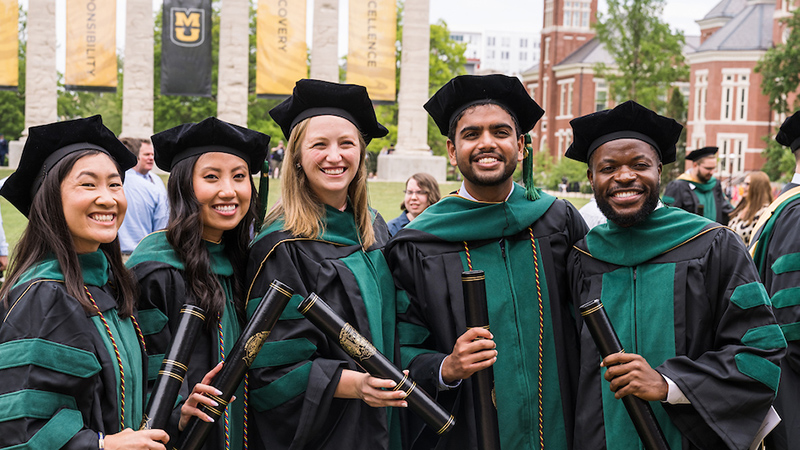
Graduation 2013 Ninety-Eight New Physicians Will
Graduate From MU Medical School

Many of the graduates will stay in state
for residency and train in primary care

Clarion Students Earn Fourth Win for MU in National Patient Safety Competition
MU wins CLARION case contest, which challenges teams to improve care outcomes

Binge Drinking Research Shows Binge Drinking Could Leave Lasting Damage
Overconsumption creates a different kind of liver damage that affects key organ functions

Destroyed by Tornado, Training Site Now Reopening in Joplin, Missouri
Mercy Hospital and MU celebrate new opportunities for future physicians

St. Baldricks MU Medical Students to Shave Their Heads for Pediatric Cancer Research
Supporters to gather April 13 at Mojo's to raise funds for St. Baldrick's Foundation
MU Internal Medicine Chair to Lead Largest Medical Specialty Group
David Fleming, MD, named president-elect of American College of Physicians

Discovery Could Increase Efficacy of Promising Cystic Fibrosis Drug
Data about defective protein described in National Academy of Sciences journal

2013 Match Day Match Day Marks Beginning of New Chapter for Medical Students
MU continues trend of producing physicians for Missouri and primary care specialties

Dongsheng Duan, PhD Discovering 'Needle in a Haystack' For Muscular Dystrophy Patients
Research on genetic sequence could lead to treatments for deadly hereditary disease

HIV Researchers Attack HIV's Final Defenses Before Mutations Emerge
Team targets enzyme that eludes current treatments to create next generation of drugs

Matheny Dermatology Manager to Lead Medical Administrators Group
Pamela Matheny named chair-elect of medical research and education assembly

Calcium Calcium Research Could Lead to Better Treatments for Aging Hearts
Federal award will expand study of element's influence on individual heart muscle cells

Headrick and Student Interprofessional Training in Quality, Safety Could Transform Health Care
Study recommends new requirements to improve education for physicians

Dr. Katti Breakthroughs in Nanomedicine Earn MU Researcher AAAS Election
Katti joins prestigious society dedicated to the advancement of science worldwide

Dr. Murad Financial Aid Coordinator Assumes National Leadership Role
Cheri Marks appointed chair of AAMC Committee on Student Financial Assistance


Office of Communications
University of Missouri School of Medicine
One Hospital Drive, MA204G, DC018.00
Columbia, MO 65212
(573) 884-0298

Laura Gerding, APR
gerdingla@health.missouri.edu
(573) 882-9193

Rich Gleba
glebar@health.missouri.edu
(573) 884-0298

Mike Muin
muinm@health.missouri.edu
(573) 884-7541


Printer Friendly
Follow us on Twitter! Facebook RSS Feed
Website created and maintained by the Office of Communications.
Contact the MU School of Medicine.
Revised: April 27, 2013 - Copyright © 2011 - The Curators of the University of Missouri.
All rights reserved. DMCA and other copyright information. An equal opportunity/affirmative action institution.