
University of Missouri School of Medicine MU Health School of Medicine
News Divider
Join us on Facebook!   Follow us on Twitter!   Subscribe to us!      


Medical Education Expansion Would Enhance Economy, Create Jobs


Clinical campus supporters announce economic impact, investment data

A plan to improve health by expanding medical education in Southwest Missouri would add more than $390 million annually to the state's economy and create 3,500 new jobs. The economic growth figures were unveiled April 6 at the Springfield Area Chamber of Commerce by supporters of establishing the city's first medical school clinical campus.

CoxHealth and Mercy health systems in Springfield and the University of Missouri School of Medicine in Columbia are designing the campus to expand MU's medical student class size and meet the need for more physicians. More than 90 percent of Missouri counties lack adequate access to health care professionals. Missouri also ranks among the top 20 states in terms of the number of people 65 and older who will require more medical care as they age. While the number of elderly is expected to double by 2030, the number of physicians who care for aging patients with chronic illnesses is expected to decline.

"Mercy, CoxHealth and MU are ideal partners for improving health by expanding access to high quality medical education," said Robert Churchill, MD, the school's Hugh E. and Sarah D. Stephenson Dean. "More Missouri physicians received their medical degree from MU than from any other university, which is due in part to MU's medical education partnerships with outstanding health systems in Springfield and other communities."

MU's School of Medicine, Mercy and CoxHealth already have a strong record of collaborating to educate physicians. Since 2005, more than 85 MU medical students have received training at Southwest Missouri health facilities through the MU School of Medicine rural track program. The program encourages physicians to complete part of their clinical education in underserved areas and to then practice in Missouri.

"CoxHealth, Mercy and MU share a history of advancing medical education and a strong commitment to improving health in the communities we serve," said Steve Edwards, president and CEO of CoxHealth. "Developing a clinical campus in Springfield would allow us to better serve patients, improve access to excellent medical education, and enhance the overall quality of life in our communities."

Each of the past two years, MU received more than 1,500 applicants to medical school, but it only has the capacity to accept 96 new medical students annually. The clinical campus would allow MU to accept 128 medical students annually, with 32 students from each class completing the second two years of their medical education in Springfield.

"Hundreds of well-qualified medical school applicants, including students from Southwest Missouri, go to other states to study and practice medicine due to a lack of access to medical education in our state," said Jon Swope, president and CEO of Mercy Springfield Communities. "The clinical campus will help keep students and physicians in Missouri, which will improve health care, education and the economy."

The Springfield-Greene County Regional Health Commission — which brings together health care leaders and providers, government agencies and community organizations to increase access to quality health care — commissioned a recently completed economic impact study for the clinical campus. Released April 6, the Community Policy Analysis Center study projects how the clinical campus would contribute to economic growth and job creation in Southwest Missouri, Mid-Missouri and across the state.

"The plan to create a clinical campus in Springfield is the most attractive economic development project that I'm aware of for Missouri," said center director Tom Johnson, PhD. "The economic contributions described in the study do not include many other community benefits that would result from this project, such as reduced travel for patients and providers and improved health for communities."

The clinical campus would require an investment in additional medical school faculty members and facilities. An approximately $30 million medical education building would need to be constructed in Columbia, and the school would require approximately $10 million in additional annual operating funding. Clinical campus supporters will coordinate their government relations, fundraising and other resources to secure the funding.

Medical Education at the University of Missouri in Columbia

At the University of Missouri School of Medicine in Columbia and most other medical schools, students complete four years of education to receive a medical degree and become a physician. Students primarily spend the first two years learning foundational aspects of medicine in educational facilities — such as classrooms, labs, libraries and auditoriums — from a variety of biomedical scientists and physician educators. Students spend much of the final two years of medical school in patient-care facilities such as hospitals and clinics.This clinical component of medical student education involves directly interacting with patients under the supervision of physicians practicing in a variety of specialties, such as family and community medicine, internal medicine, pediatrics, surgery, neurology, psychiatry, obstetrics and gynecology.

MU medical students also have the opportunity to complete part of their clinical education at hospitals and clinics throughout rural Missouri, including CoxHealth and Mercy hospitals and clinics. As a result, MU medical students receive clinical education in a variety of settings that represent the diverse health care needs of Missouri.

Throughout their four years of medical school, MU medical students benefit from a wide variety of educational opportunities. For more than 165 years, the University of Missouri in Columbia has educated medical students and conducted medical research in partnership with hospitals and clinics and life sciences schools across campus. These resources have made MU one of only 34 public universities, and the only public institution in Missouri, to be selected for membership in the Association of American Universities. MU also is designated as "Research University/Very High" and "Community-Engaged" by the Carnegie Foundation for the Advancement of Teaching.


Alumni Newsletter: Medicine@Mizzou

Medical School Update Clinical Research Center Opens
Comprehensive facility supports clinical
and translational scientists across MU in
developing new treatments and devices

Faculty and Staff Newsletter: Roar

ROAR Attacking HIV's Final Defenses
With a $3.4 million grant, MU is leading a
team of HIV researchers who are finding
new pathways for shutting down the virus

Magazine: Missouri Medical Review

Missouri Medical Review Better Combat Care
MU's surgery department is awarded a
$5.3 million grant to improve military medical training by using clinical simulation technology

Divider

News and Events

Graduation 2013 MU Ranked Among Top Schools
For Training in Family Medicine

Family medicine program among 12 tapped for special recognition by national academy

Graduation 2013 Ninety-Eight New Physicians Will
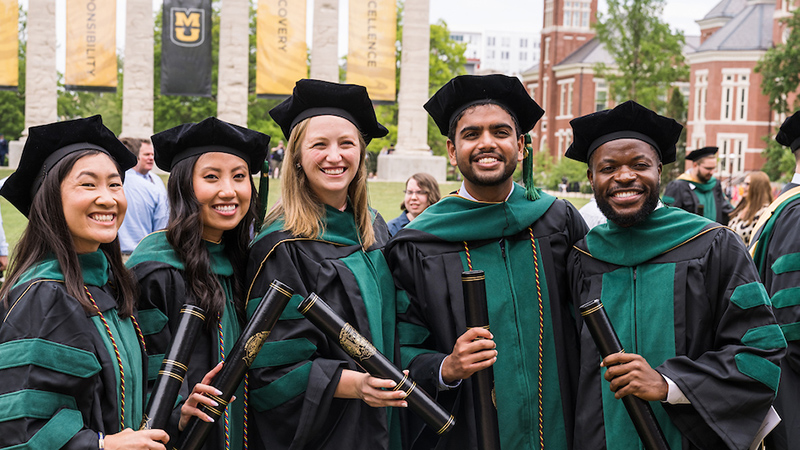
Graduate From MU Medical School

Many of the graduates will stay in state
for residency and train in primary care

Clarion Students Earn Fourth Win for MU in National Patient Safety Competition
MU wins CLARION case contest, which challenges teams to improve care outcomes

Binge Drinking Research Shows Binge Drinking Could Leave Lasting Damage
Overconsumption creates a different kind of liver damage that affects key organ functions

Destroyed by Tornado, Training Site Now Reopening in Joplin, Missouri
Mercy Hospital and MU celebrate new opportunities for future physicians

St. Baldricks MU Medical Students to Shave Their Heads for Pediatric Cancer Research
Supporters to gather April 13 at Mojo's to raise funds for St. Baldrick's Foundation
MU Internal Medicine Chair to Lead Largest Medical Specialty Group
David Fleming, MD, named president-elect of American College of Physicians

Discovery Could Increase Efficacy of Promising Cystic Fibrosis Drug
Data about defective protein described in National Academy of Sciences journal

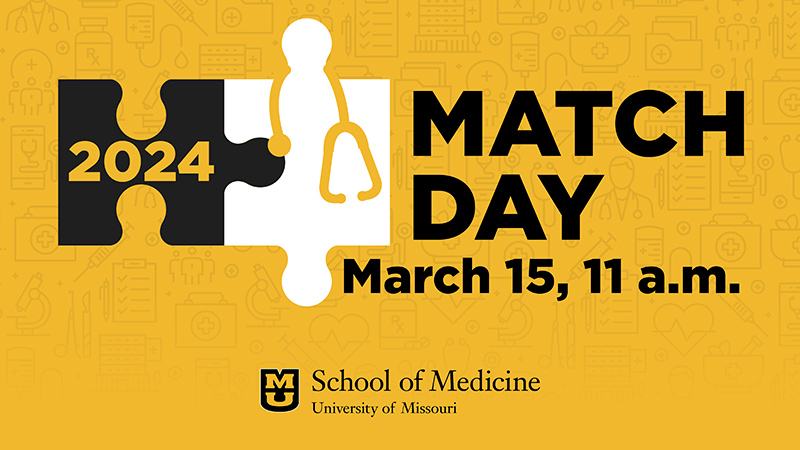
2013 Match Day Match Day Marks Beginning of New Chapter for Medical Students
MU continues trend of producing physicians for Missouri and primary care specialties

Dongsheng Duan, PhD Discovering 'Needle in a Haystack' For Muscular Dystrophy Patients
Research on genetic sequence could lead to treatments for deadly hereditary disease

HIV Researchers Attack HIV's Final Defenses Before Mutations Emerge
Team targets enzyme that eludes current treatments to create next generation of drugs

Matheny Dermatology Manager to Lead Medical Administrators Group
Pamela Matheny named chair-elect of medical research and education assembly

Calcium Calcium Research Could Lead to Better Treatments for Aging Hearts
Federal award will expand study of element's influence on individual heart muscle cells

Headrick and Student Interprofessional Training in Quality, Safety Could Transform Health Care
Study recommends new requirements to improve education for physicians

Dr. Katti Breakthroughs in Nanomedicine Earn MU Researcher AAAS Election
Katti joins prestigious society dedicated to the advancement of science worldwide


Office of Communications
University of Missouri School of Medicine
One Hospital Drive, MA204G, DC018.00
Columbia, MO 65212
(573) 884-0298

Laura Gerding, APR
gerdingla@health.missouri.edu
(573) 882-9193

Rich Gleba
glebar@health.missouri.edu
(573) 884-0298

Mike Muin
muinm@health.missouri.edu
(573) 884-7541


Printer Friendly
Follow us on Twitter! Facebook RSS Feed
Website created and maintained by the Office of Communications.
Contact the MU School of Medicine.
Revised: April 27, 2013 - Copyright © 2011 - The Curators of the University of Missouri.
All rights reserved. DMCA and other copyright information. An equal opportunity/affirmative action institution.