
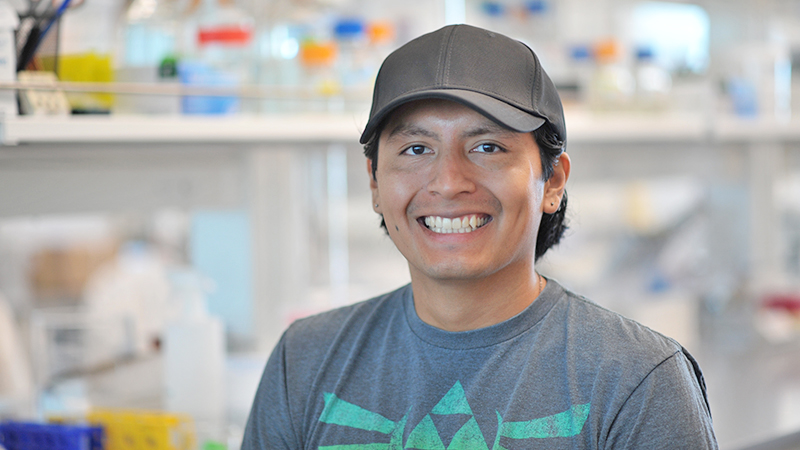
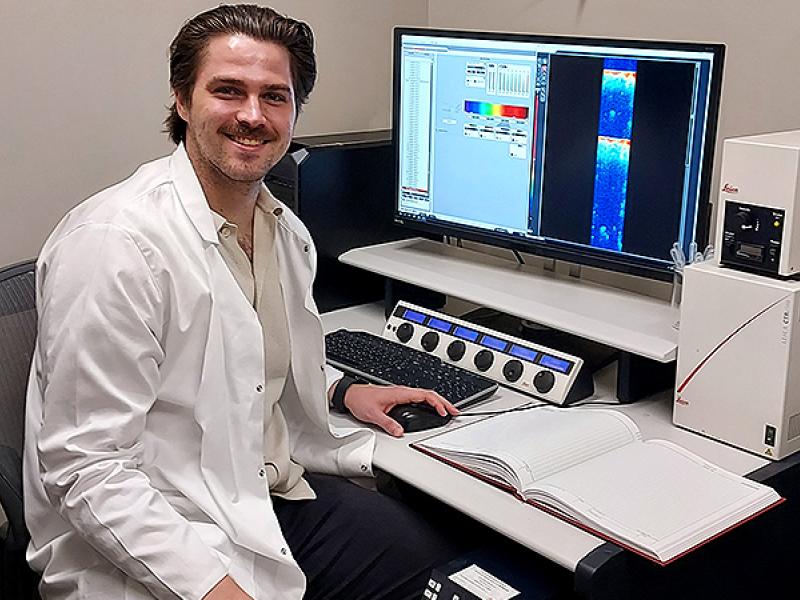
Jeffery Erickson, a doctoral candidate in the Translational Biosciences PhD program at the University of Missouri, recently defended his dissertation, marking a significant milestone in his academic and research career. His research, conducted under the mentorship of Wipawee Winuthayanon, BSN, PhD, explores innovative approaches to contraceptive development with a focus on non-hormonal methods.
Erickson's dissertation centers on developing a new non-hormonal contraceptive strategy by targeting prostate specific antigen (PSA)—a protein essential in the early stages of sperm motility. PSA works by degrading the gelatinous semen coagulum shortly after it’s released, freeing sperm to move progressively up the female reproductive tract. His research aims to inhibit PSA’s activity, thereby trapping sperm within the coagulum and preventing their motility, a process critical to successful fertilization.
“We hope that by blocking PSA’s degradation of coagulated semen, sperm will remain entrapped and unable to travel effectively,” said Erickson. “This could be a promising step toward developing a safe and effective non-hormonal contraceptive method.”
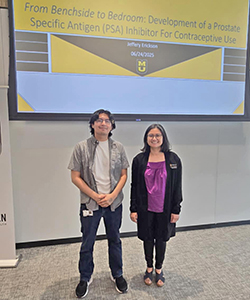
Erickson expressed deep gratitude for the guidance and support he received throughout his doctoral studies.
“All my research and professional development could not have been done without the support of my advisors and committee members, especially my mentor Dr. Wipawee (Joy) Winuthayanon,” said Erickson. “Her mentorship has been instrumental in shaping both my scientific thinking and professional growth.”
Dr. Winuthayanon reflected on her time mentoring Erickson with pride and admiration.
“Mentoring Jeffery through his PhD journey has been a true privilege,” said Dr. Winuthayanon. “From the beginning, he brought curiosity, determination and a collaborative spirit to every challenge. His ability to think critically, design elegant experiments and communicate science with clarity has grown tremendously over the years. I'm incredibly proud of the scientist and person he has become, and I’m excited to see the impact he will make in the next phase of his career.”
As he transitions from graduate school into the next chapter of his professional life, Erickson is focused on continuing his contributions to the field of reproductive biology.
“I hope to remain involved in contraceptive development research and expand my experience in teaching,” said Erickson. “In the future, I aspire to obtain an academic faculty position where I can guide undergraduate research and teach courses focused on cellular and reproductive biology.”
Erickson’s successful dissertation defense not only marks the completion of a rigorous doctoral program, but also the beginning of a career driven by scientific innovation, education, and mentorship. The Mizzou School of Medicine community celebrates his achievement and looks forward to the contributions he will make in science and academia.
Related News
Dr. Ai-Ling Lin earns 2026 Distinguished Investigator Award

Dr. Young-Walker earns 2026 AAMC Presidential Award
Behrmann awarded NIH Predoctoral Fellowship Award