
One of the biggest obstacles when treating cancer is that there isn’t a great way for current therapies to target only cancerous cells, often causing harm to nearby healthy cells. While radiation therapy can already deliver at the accuracy of a millimeter, the damage and the side effects that follow limit how much radiation a patient can safely receive.
A newer technology takes a different approach: instead of changing where the radiation goes, it changes how fast it arrives.
Researchers from the University of Missouri School of Medicine recently received a $1 million grant from the National Institutes of Health to study the latest technology in cancer research – the TheryQ FLASHKNiFE system, a platform that can quickly deliver doses of radiation to tumors while appearing to reduce damage to nearby tissue, according to preclinical studies.
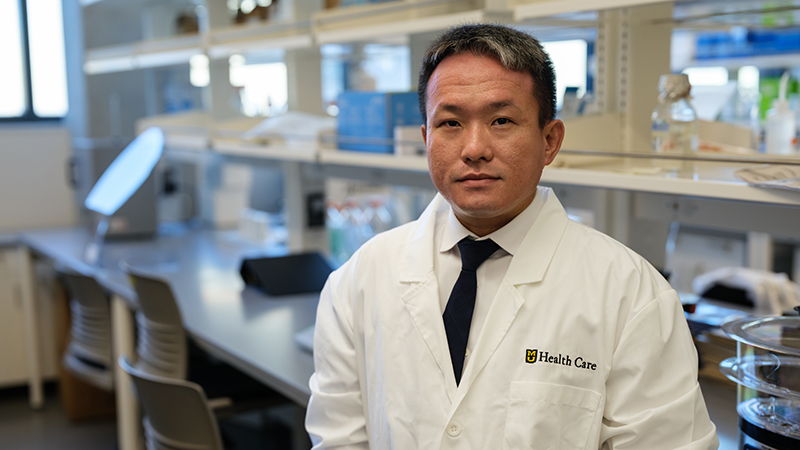
“This grant fills a critical technological gap in our cancer research capabilities,” grant recipient Rongxiao Zhang said. “The system delivers treatment in a fraction of a second, roughly a thousand times faster and at dose rates hundreds of times higher than a conventional machine.”
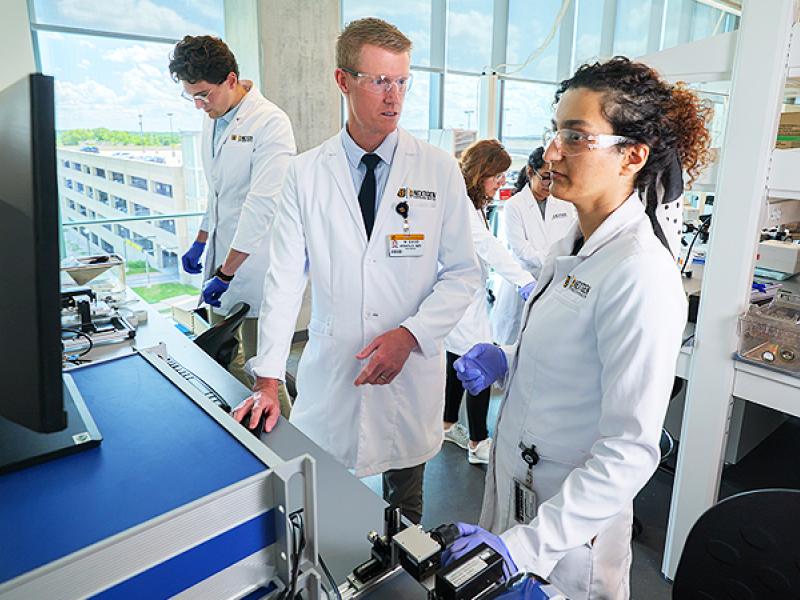
Multiple Mizzou researchers will have access to the FLASHKNiFE system, which will be housed in the Roy Blunt NextGen Precision Health Building. Zhang, for his part, will help develop tools for treatment planning and dose verification. He’ll also study and measure how the ultra-fast beams themselves work and their reliability.
“While this isn’t currently approved to treat people with cancer, our work sets the foundation for safe and reliable use of FLASH radiotherapy,” Zhang said. “Our broader goal with this technology is to accelerate its use in future experiments and clinical trials so it may be available for patient care more quickly.”
Since the system can deliver radiation doses in a controlled and measured way, allowing for easy comparison between FLASH and conventional delivery, FLASHKNiFE may be useful for research beyond cancer. This includes studies of radiation-induced injuries in organs like the liver or lung. The same principle of potentially sparing normal tissue could be later applied during tumor radiation treatment to reduce injury to nearby, healthy organs.
“At Mizzou, we have a number of robust institutional resources,” Zhang said. “By leveraging our strengths and the expertise of our researchers at the MU Research Reactor, our top-tier College of Veterinary Medicine and the NextGen Precision Health building, we are positioning Mizzou at the forefront of cancer research and beyond.”
Rongxiao Zhang, PhD, DABR is an associate professor of Radiation Oncology at the Mizzou School of Medicine, and the Division Director of Medical Physics. The NIH grant will provide $1 million and will last until June 2027.