
Spinal cord injuries (SCIs) can be devastating. Depending on where the damage is, it could cause loss of function and put people at greater risk of developing other health problems. According to a recent study, researchers from the University of Missouri School of Medicine tested a therapeutic strategy that may improve the cardiovascular health of people with SCIs.
Dysfunction in the cardiovascular system is one of the leading causes of death or developing other conditions in patients with an SCI. This is because the system becomes unstable from the disruption in nerve communication. Mizzou researchers found that transplanting a special type of cell collected from the nervous system can restore nerve control over the circulatory system.

“In our rat model, we harvested cells from either the spinal cord or the brain stem that haven’t finished differentiating, or specializing,” said study author Shaoping Hou. “After transplanting them to the site of injury, we saw that cardiovascular function improved. For example, resting blood pressure stabilized, and the average heart rate decreased.”
While some nerve control was restored, there wasn't a decrease in hormonal control of the cardiovascular system, which rises after an SCI to compensate for the loss of regulation. The increased activity can have detrimental effects.
“Increased hormonal activity can damage the circulatory system, meaning the blood vessels and even the heart,” Hou said. “It can cause the vessel walls to stiffen and become less flexible, impeding blood flow, and even change how they’re structured or function.”
As a result, these changes can lead to high blood pressure, plaque buildup, uncontrolled inflammation or, at worst, heart failure.
“Our future research will focus on discovering how to maintain the restoration of nerve function while reducing the body’s reliance on hormonal regulation, which can stiffen blood vessels,” Hou said. “This therapy has the potential to protect patients’ cardiovascular health after they’ve already experienced an intense injury.”
Shaoping Hou, PhD is an associate professor of Pathology and Anatomical Sciences and Physical Medicine and Rehabilitation at the Mizzou School of Medicine and is also an investigator at the Dalton Cardiovascular Research Center (DCRC).
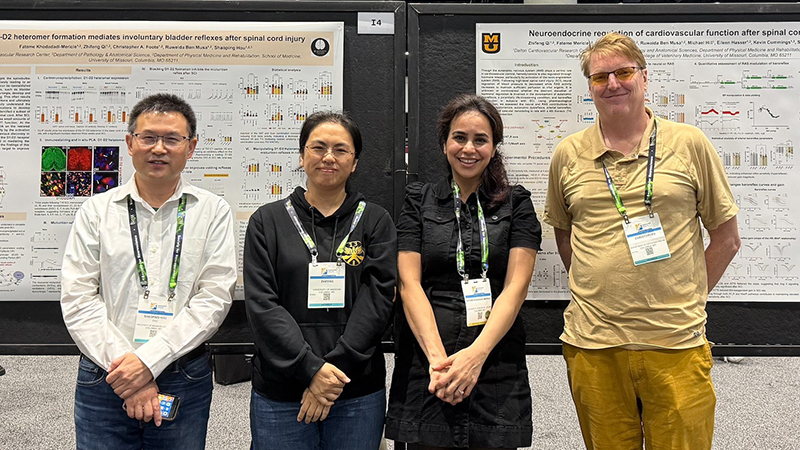
“Transplanting neural progenitor cells improves neural regulation but not hormonal reliance of cardiovascular function following spinal cord injury” was recently published in eNeuro, a journal of the Society for Neuroscience. In addition to Hou, Mizzou study authors include Fateme Khodadadi-Mericle, post-doctoral fellow at DCRC and Zhifeng Qi, senior research associate at DCRC. Cameron Trueblood, Silvia Fernandes, Theresa Conners, Micaela O’Reilly, John Houle and Veronica Tom from Drexel University contributed.