
Dear Colleagues,
I recently had the privilege of joining a group of our medical students for a truly remarkable experience at Ellis Library. With the guidance of our librarian, Dr. John Henry, we visited the special collections viewing room on the fourth floor. It’s a place where some of the University of Missouri’s most treasured antiquarian books in science are carefully preserved.
Together, we examined rare and historic volumes that shaped the very foundation of modern science and medicine. It was an unforgettable chance for our students to not only see but actually handle these priceless works. In years past, white gloves were required for such handling, but preservationists have since learned that clean, bare hands are safer for the books. So, after washing our hands thoroughly, we turned the pages of history.
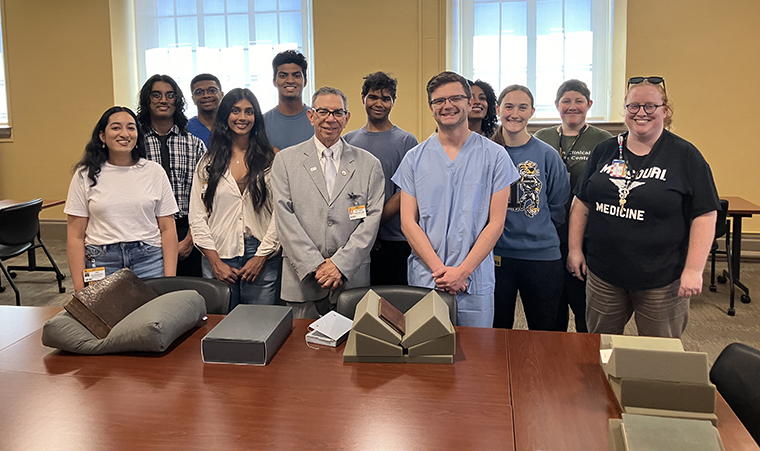
We began with astronomy and physics, holding a first edition of Galileo’s groundbreaking work from 1630, in which he confirmed—using the newly invented telescope—that the Earth revolves around the sun. We then examined two of Isaac Newton’s major contributions from the early 1700s: one on gravity and another on optics.
From there, we moved to medicine. The students read an early edition of Thomas Willis’s anatomy text, also from the 1700s, where he described the intricate blood vessels of the brain, what medical students still call the “Circle of Willis” today. We then turned to a first edition by Charles Bell from the early 1800s, where he detailed the anatomy of the facial nerve and the clinical features of facial paralysis, now universally known as “Bell’s Palsy.”
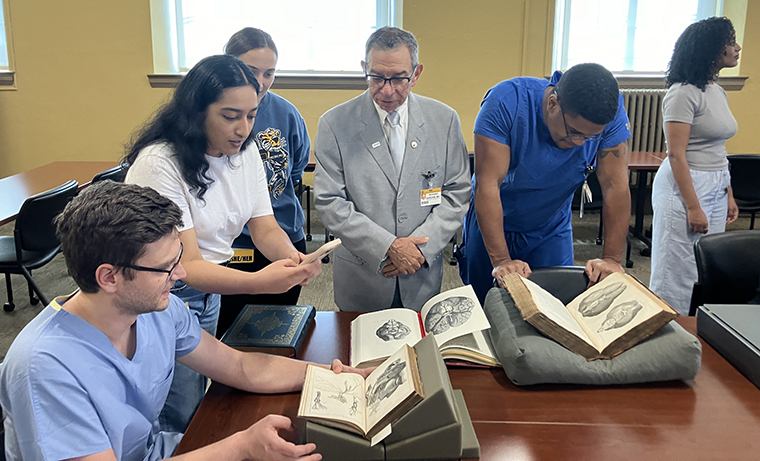
I could sense how deeply this unique opportunity resonated with the students to touch the very books that introduced concepts they are studying today. Isaac Newton once said, “We can see further because we are standing on the shoulders of giants.” This visit gave our students the chance to quite literally meet those giants whose discoveries continue to shape their training.
I am confident that these kinds of experiences will enrich their education and help prepare them to be thoughtful, compassionate physicians who carry forward the legacy of scientific discovery and patient care.
I want to extend my sincere thanks to Ellis Library and our librarians, especially Dr. John Henry, for making this experience possible. Their stewardship of these collections ensures that our students can connect with the history of science and medicine in ways that inspire learning for generations to come.
Sincerely,

Rick Barohn, MD
Executive Vice Chancellor for Health Affairs and Hugh E. and Sarah D. Stephenson Dean, School of Medicine
rbarohn@health.missouri.edu